


How a Company Pays for a Hotel on a Business Trip: Four Ways and What Each Costs
The payment method determines whether the company receives an ESF and can claim the VAT as a credit. We compare an employee card, a corporate card, cash, and an invoice to the legal entity.
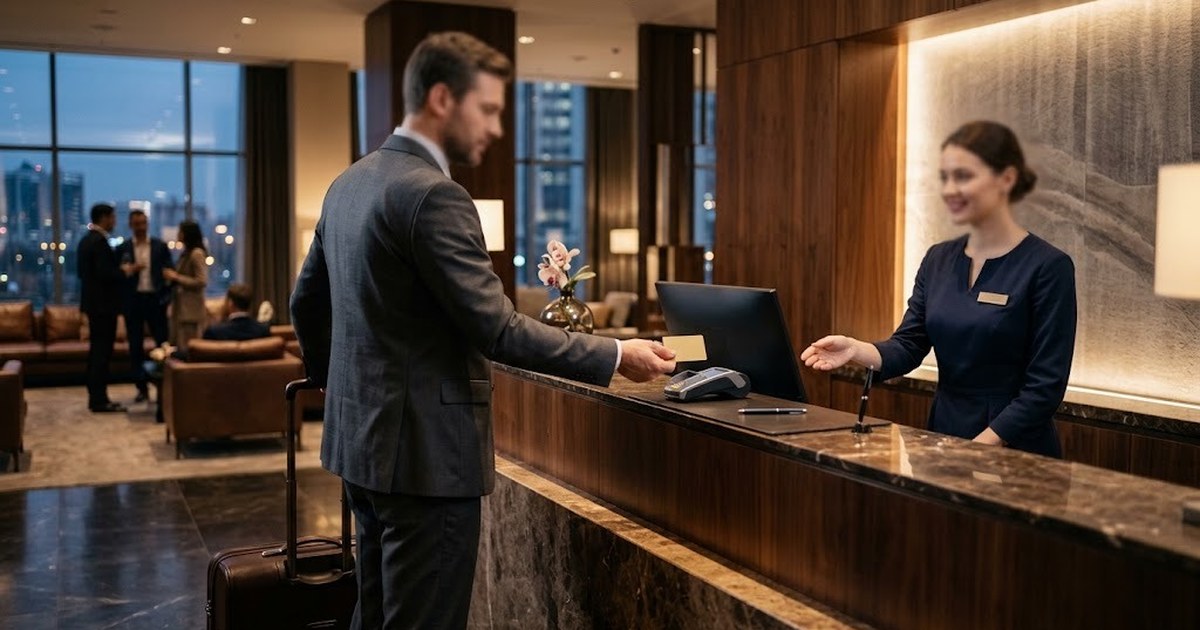
So the hotel checks the employee in and invoices the company instead of charging the guest.
The question seems mundane — what difference does it make who hands over the card at the reception desk? But the payment method determines which documents accounting receives, whether the company can claim the VAT as an offset, and how long it takes to close out the trip. Let's go through four methods and what each means for bookkeeping.
This article is an overview of practice, not tax advice. Check the details with your accountant and the current edition of the Tax Code.
Why this is not a minor matter
From 2026, the VAT rate is 16%, and the threshold for VAT registration has been lowered, so small hotels have also become VAT payers. If a room costs 50,000 ₸ including tax, the VAT is about 6,900 ₸. A company can claim it as an offset only under one condition: there is an electronic invoice (ESF) issued to a legal entity. If the buyer in the documents turns out to be an employee as an individual, there is no offset — the money is simply lost.
The second side is time. Every trip paid for by an employee turns into an expense report, collecting receipts and corresponding with the hotel. With ten trips a month, this is a separate job for the accountant.
Method 1. The employee pays with their own money
The most common and most inconvenient option: the person pays for the room with their own card, and the company reimburses them via an expense report.
- What accounting will receive. A fiscal receipt issued to an individual. Expenses under it can be deducted for corporate income tax, but the VAT cannot be claimed as an offset: no invoice is issued to the company if the buyer paid as an ordinary guest.
- How to save the situation. Give the employee the company's details in advance and ask them to have the hotel reception issue an invoice and act in the name of the legal entity. This does not always work: if the receipt in the individual's name has already been printed, the hotel usually will not redo the documents.
- Risk. The employee is effectively lending the company their own money, and if the trip is cancelled the refund goes to their card.
Method 2. Corporate card
The card is linked to the company's account, and the employee pays with it.
- Plus. The company's money is used, the employee takes no financial risk, and no cash advances are issued.
- Minus. The hotel still sees a guest in front of it, not an organization. To receive an ESF, you still need to pass on the details in advance and request an invoice to the company — otherwise the story repeats Method 1.
- Keep in mind. Even with a corporate card, an expense report with supporting documents is still required: the bank statement does not confirm the expense.
Method 3. Cash advance
Money is issued from the cash register before the trip, and the employee pays in cash.
- A fiscal receipt from the cash register (KKM) is mandatory. Without it, the expense is not confirmed.
- VAT offset — only if the hotel additionally issues an ESF to the company, which is rare when a guest pays in cash.
- Extra burden — cash discipline, expense orders, returning any leftover balance. For a company with several trips a month, this is an extra cycle of documents.
Method 4. Invoice to the company and non-cash payment
The hotel issues an invoice to the legal entity, the company pays from its current account, and after checkout it receives an act and an ESF.
- The documents come out correct right away: the buyer is the company, your BIN appears in the documents, and the VAT is claimed as an offset.
- The employee spends no personal money, and the accommodation does not appear in their expense report at all — only the per diem and minor expenses remain there.
- What you need to do: send the hotel your details in advance, agree on payment before or after check-in, and make sure the ESF is actually issued.
- Limitation. Not every hotel works with legal entities without a contract, and at exhibitions and in high season venues ask for prepayment.
Comparison of methods
| Method | Documents | VAT offset | Expense report | Who bears the financial risk |
|---|---|---|---|---|
| Employee's card | Receipt in the individual's name | Usually no | Required | Employee |
| Corporate card | Receipt; invoice and act if agreed | Only with an ESF to the company | Required | Company |
| Cash | Fiscal receipt | Rarely | Required | Company |
| Invoice to the company | Invoice, act, ESF | Yes | Not required for accommodation | Company |
What should come from the hotel
Regardless of payment method, the complete set of documents for a legal entity's accommodation looks like this:
- Invoice for payment — with the company name, BIN, dates of stay, and the guest's surname.
- Act of completed services or another document confirming the service was rendered.
- Electronic invoice (ESF) in the ESF information system, if the hotel is a VAT payer. How to obtain it and what to check in it — in the article on ESF for accommodation.
- Fiscal receipt — when paying in cash or by card on site.
Check three things in the ESF: your BIN, the period of stay, and the amount with the VAT shown separately. A mistake in the BIN turns the document into someone else's.
Prepayment or payment after checkout
Prepayment is convenient for the hotel but disadvantageous for the company: if the trip is cancelled, the money is refunded slowly, and a non-refundable rate is not refunded at all. Postpayment — payment by invoice after checkout — removes this risk, but not everyone offers it: usually a contract and booking history are required.
If the trip might fall through, pay attention to the cancellation terms, not just the room price. The difference between a refundable and a non-refundable rate is often less than the cost of one cancelled booking. For how to compare offers, see the article how to choose a hotel for a business trip.
What to choose
For a one-off trip to another city, any method will do — the main thing is to pass on the details in advance and ask for an invoice to the company. If you make more than two or three trips a month, the only method that does not consume accounting time is payment by invoice to the legal entity.
This is how it works at Rentus: the company books business hotels at corporate rates, the employee doesn't have to pay with their own card, and the invoice, act, and ESF arrive at the company's details. A separate contract with each hotel is not required.
Questions and answers
Can the company claim VAT as a credit if the employee paid for the hotel with their own card?
As a rule, no. The tax invoice is issued to the buyer, and when a guest who is an individual pays and receives a fiscal receipt, the hotel is not required to issue an ESF to the company. Expenses can be deducted for corporate income tax, but VAT cannot be claimed as a credit.
Is an expense report needed if the corporate card was used?
Yes. A bank statement alone does not confirm expenses: the expense report must include the invoice, the act, the receipt, and the ESF. Only what the company paid directly against an invoice does not go into the expense report.
What documents should the hotel provide to a legal entity?
A payment invoice, a certificate of completed work, and an electronic tax invoice (ESF) if the hotel is a VAT payer. When paying on site, a fiscal receipt from the cash register machine is also added.
What should be done if the hotel refuses to issue documents to the company?
Agree on this before check-in: send the company details and ask for an invoice to the legal entity. If the hotel has already issued a receipt to the guest, reissuing it depends on the hotel's goodwill. It is more reliable to choose platforms that from the start work with companies on invoice terms.
Which is safer, prepayment or payment after departure?
For the company, payment after the stay is safer: if the trip is cancelled, the money does not get stuck with the hotel. Prepayment is usually requested for exhibitions and in high season, and non-refundable rates are not refunded at all upon cancellation.
The text, translation and images for this article were prepared with the help of artificial intelligence. AI can make mistakes — check important figures, dates and requirements against official sources.
Verified business hotels at closed corporate rates, with the invoice, act and e-invoice for your company — all in one account.
 Photo generated by AI
12 November 2026Why Are Almaty Hotels So Expensive? Comparing Them With Europe, Turkey and Asia
 Photo: AkylbekovAS
12 November 2026Lake Zaysan: How to Get There, When to Go and What to See Nearby
 Photo: Alfira Khissamutdin
12 November 2026Oi-Qaragai and Lesnaya Skazka: Prices, Cable Cars and How to Get There from Almaty
 Photo generated by AI
9 November 2026Universal Studios Beijing: Tickets, Harry Potter, Visa and Getting There
 Photo generated by AI
9 November 2026Disneylands of the World: 12 Parks, Ticket Prices, Visas and Flights
 Video: Mohammad Usaid Abbasi
9 November 2026Where to Find the Wizarding World of Harry Potter: Universal Parks and Warner Bros. Studios
 Photo: Benjamin Smith
9 November 2026Where Hogwarts Really Is: Castles, Filming Locations and Theme Parks
 Photo generated by AI
9 November 2026Tokyo Disneyland and DisneySea: Tickets, Visa and Getting There
 Photo generated by AI
9 November 2026Shanghai Disneyland: Tickets, Getting There, Visa and Tips
 Photo generated by AI
9 November 2026Disneyland Paris: Tickets, Visa, Getting There and Hotels
 Photo generated by AI
9 November 2026Hong Kong Disneyland: Tickets, Visa and Getting There
 Photo generated by AI
6 November 2026New Year 2027 in Kazakhstan: Days Off and Where to Go
All articles
Business trips, documents and cities of Kazakhstan