


Accommodation on Business Trips: Rules, Limits and Documents in 2026
How much you can spend on a hotel, where the law sets the limit and where the company decides, and which hotel documents you need so that accommodation does not become income for the employee.
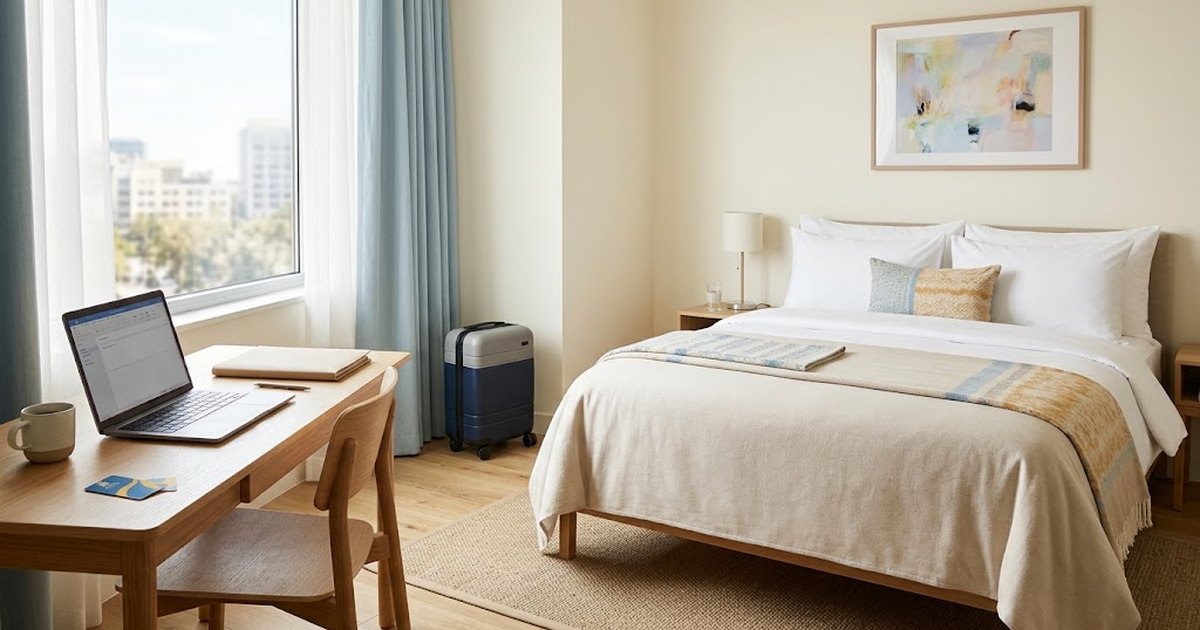
Accommodation is usually the largest expense item on a business trip, and accounting hears the question "what's our hotel limit?" more often than any other. The answer depends on who pays. For government agencies, the limit is set in MRP and recalculated every year. For a private company, the law sets no limit: what matters are internal rules and documents from the hotel. Let's look at both situations using 2026 figures.
This article is an overview of general rules, not tax advice. The reimbursement procedure in your company depends on the business travel regulations and accounting policy: check the details with your accountant and the current versions of the codes.
What the law says
Article 127 of the Labor Code of the Republic of Kazakhstan lists what an employer pays a traveling employee: per diem for calendar days of the trip, travel there and back, and accommodation costs. The code does not name an amount. Under the same article, business trip conditions are determined by the employment or collective agreement or by an employer's act, that is, the order and the business travel regulations.
So there are two accommodation norms, and they do not overlap:
- for trips paid from the budget — the limits of the Rules for Reimbursement of Expenses for Official Business Trips, approved by Government Resolution No. 256 of May 11, 2018;
- for private companies — a limit the company sets for itself. In this case the Tax Code looks not at the amount but at the documents.
Norms for government agencies in 2026
Rules No. 256 set the reimbursement cap per night in monthly calculation indices (MCI). In 2026, the MCI equals 4,325 ₸ — converted to tenge:
| Locality | Government agency employees | Heads and their deputies |
|---|---|---|
| Astana, Almaty, Shymkent, Atyrau, Aktau, Baikonur | up to 7 MRP — 30,275 ₸ | up to 10 MRP — 43,250 ₸ |
| Regional centers and cities of regional significance | up to 6 MRP — 25,950 ₸ | up to 7 MRP — 30,275 ₸ |
| District centers, cities of district significance, Borovoye settlement | up to 4 MRP — 17,300 ₸ | up to 5 MRP — 21,625 ₸ |
| Rural districts | up to 2 MRP — 8,650 ₸ | — |
A few more rules from the same document that people often forget:
- Booking is paid separately. The cost of reserving a hotel room is reimbursed above the norm, if there is a supporting document.
- Per diem in government agencies is 2 MRP, that is, 8,650 ₸ per day across Kazakhstan. This is less than the non-taxable limit for businesses.
- If an employee can return home every day and does, they are reimbursed only for travel — no per diem and no accommodation. The manager decides this, taking into account distance and transport.
- If the employee falls ill during the trip, accommodation continues to be reimbursed until they return to the assignment or home, but no longer than 40 days. The exception is inpatient treatment.
- The trip report with documents is submitted within five working days of returning.
These norms are mandatory for trips paid from budget funds. They are not mandatory for private business, but they are often used as a benchmark when drafting its own regulations.
Norms for a private company
For business, two articles of the Tax Code, in force since January 1, 2026, are important.
Article 366 — accommodation expenses are not considered the employee's income if confirmed by documents, including electronic ones. Unlike per diems, accommodation has no MRP cap: the amount reimbursed against documents is not subject to personal income tax (PIT), no matter how much the room costs.
Article 260 — the company deducts accommodation expenses for corporate income tax (CIT) purposes, including the booking payment. The condition is the same — documents.
It follows that the hotel limit in a private company is a matter of internal discipline, not tax. It is set in the business travel regulations, and it is most convenient to do it the way the state does, in MRP: then the amount will grow automatically along with the index next year.
An example of an internal policy — not a legal norm, but a model of the approach:
| Category | Large cities | Other cities |
|---|---|---|
| Employees | up to 7 MRP per night | up to 6 MRP per night |
| Managers | up to 10 MRP per night | up to 7 MRP per night |
| Exceeding the limit | written approval from the manager before booking | |
If a room costs more than the limit, there are two honest options: the employee pays the difference themselves, or the manager gives written approval for an exception — for example, during a major exhibition when there are no cheap rooms in the city. It is better to fix both options in the regulations in advance, so you don't have to decide them after the trip.
Which documents are needed from the hotel
The set depends on who pays.
| Who pays | Documents | Comment |
|---|---|---|
| Employee pays, company reimburses | Invoice or receipt with dates and guest name, cash receipt or other proof of payment | Attached to the advance report |
| Company pays by invoice | Payment invoice, act of services rendered, electronic invoice (ESF) if the hotel is a VAT payer | No advance report for accommodation is needed |
Check the check-in and check-out dates, the employee's name, and the seller's details in the documents — accounting uses them to link the stay to the order. If the company is a VAT payer, the tax can be credited only with an ESF issued to the company. A receipt paid with the employee's personal card will not qualify for the credit.
What happens if there are no documents
Article 366 exempts accommodation from tax only when documents are available. Without them, the reimbursement becomes the employee's income: PIT is withheld from it, and the company loses the CIT deduction. Typical causes:
- A lost receipt. Ask the hotel for a duplicate or a copy of the invoice — most hotels keep them in their system.
- The hotel does not issue documents. Small guesthouses sometimes operate without cash receipts. Choose a place that issues documents already at the booking stage.
- A short-term rental apartment from a private individual. Documents for such rentals are often disputed. Agree in advance with your accountant what your accounting policy accepts: a rental agreement, a receipt, a bank transfer.
Special cases
- Extra nights. Trip days are counted according to the order and the dates in the travel documents. If the employee stayed over the weekend on their own initiative, those nights are their personal expense. If the trip was extended for work reasons, an order extending the trip is needed.
- Illness during a trip. Under Article 260 of the Tax Code, accommodation during days of incapacity also goes to deductions, provided the employee is not in an inpatient facility.
- A foreign business trip. For government agencies, accommodation norms in dollars and euros are set in the annex to Rules No. 256. For private companies, the same documentation principle applies — more in the article on business trips abroad.
- VAT on the invoice. From 2026 the VAT rate is 16%, and many small hotels have become VAT payers. How this changes the calculations is covered in the article about 16% VAT and business trips.
What to record in the business travel regulations
- the accommodation limit by city and position — in MRP or in tenge;
- who approves exceeding the limit and how;
- who books the hotel: the employee personally or the company on its own details;
- which documents are accepted for accommodation, including electronic ones;
- rules for short-term apartments and guesthouses;
- the deadline for submitting the advance report.
A ready-made sample of the regulations is in the article "Business Travel Regulations: Sample", and forms are on the document templates page.
How to avoid lost receipts
Most accommodation problems arise when the employee pays personally: the receipt gets lost, documents are issued to an individual, and VAT cannot be credited. On Rentus, a company books a business hotel on its own details and sees the price in advance, so the limit from the regulations is easy to keep. The invoice, closing documents and ESF arrive at the company's details automatically. Register your company — prices and booking will become available after verification.
Questions and answers
What is the accommodation allowance for a business trip in 2026?
For government bodies, under Rules No. 256: up to 7 MRP per day (30,275 ₸) in Astana, Almaty, Shymkent, Atyrau, Aktau and Baikonur; up to 6 MRP (25,950 ₸) in regional centers; up to 4 MRP (17,300 ₸) in district centers; and up to 2 MRP (8,650 ₸) in rural districts. For private companies, the law sets no limit — the company establishes the limit itself.
Is the hotel payment for a business trip subject to personal income tax (IPN)?
No, if the expenses are confirmed by documents. Under Article 366 of the Tax Code, accommodation on a business trip is not considered an employee's income, and there is no MRP-based limit for it, as there is for daily allowances. Without documents, the reimbursement becomes income and is subject to IPN.
Can accommodation costs above the company's limit be reimbursed?
Yes, if the business travel regulation allows it — for example, with the written consent of the manager. For tax purposes, exceeding the internal limit makes no difference: what matters is the documents. If the regulation does not allow it, the employee pays the difference.
What documents are needed from the hotel for an advance report?
An invoice or receipt showing the dates of stay and the guest's name, plus proof of payment — a cash receipt or electronic receipt. If the company pays the hotel, you need a payment invoice, an act, and an electronic invoice (electronic tax invoice) if the hotel is a VAT payer.
Is hotel booking reimbursable?
Yes. The Tax Code explicitly includes payment for a booking in accommodation expenses. Under Rules No. 256, for government bodies, the cost of reserving a hotel room is reimbursed separately when supporting documents are provided.
The text, translation and images for this article were prepared with the help of artificial intelligence. AI can make mistakes — check important figures, dates and requirements against official sources.
Verified business hotels at closed corporate rates, with the invoice, act and e-invoice for your company — all in one account.
 Photo generated by AI
12 November 2026Why Are Almaty Hotels So Expensive? Comparing Them With Europe, Turkey and Asia
 Photo: AkylbekovAS
12 November 2026Lake Zaysan: How to Get There, When to Go and What to See Nearby
 Photo: Alfira Khissamutdin
12 November 2026Oi-Qaragai and Lesnaya Skazka: Prices, Cable Cars and How to Get There from Almaty
 Photo generated by AI
9 November 2026Universal Studios Beijing: Tickets, Harry Potter, Visa and Getting There
 Photo generated by AI
9 November 2026Disneylands of the World: 12 Parks, Ticket Prices, Visas and Flights
 Video: Mohammad Usaid Abbasi
9 November 2026Where to Find the Wizarding World of Harry Potter: Universal Parks and Warner Bros. Studios
 Photo: Benjamin Smith
9 November 2026Where Hogwarts Really Is: Castles, Filming Locations and Theme Parks
 Photo generated by AI
9 November 2026Tokyo Disneyland and DisneySea: Tickets, Visa and Getting There
 Photo generated by AI
9 November 2026Shanghai Disneyland: Tickets, Getting There, Visa and Tips
 Photo generated by AI
9 November 2026Disneyland Paris: Tickets, Visa, Getting There and Hotels
 Photo generated by AI
9 November 2026Hong Kong Disneyland: Tickets, Visa and Getting There
 Photo generated by AI
6 November 2026New Year 2027 in Kazakhstan: Days Off and Where to Go
All articles
Business trips, documents and cities of Kazakhstan