


How a Hotel Works with Legal Entities: Invoice, Act and ESF
A corporate guest brings steady, predictable business, but leaves for good if accounting doesn't receive the documents. Here is what a hotel should issue, and when.
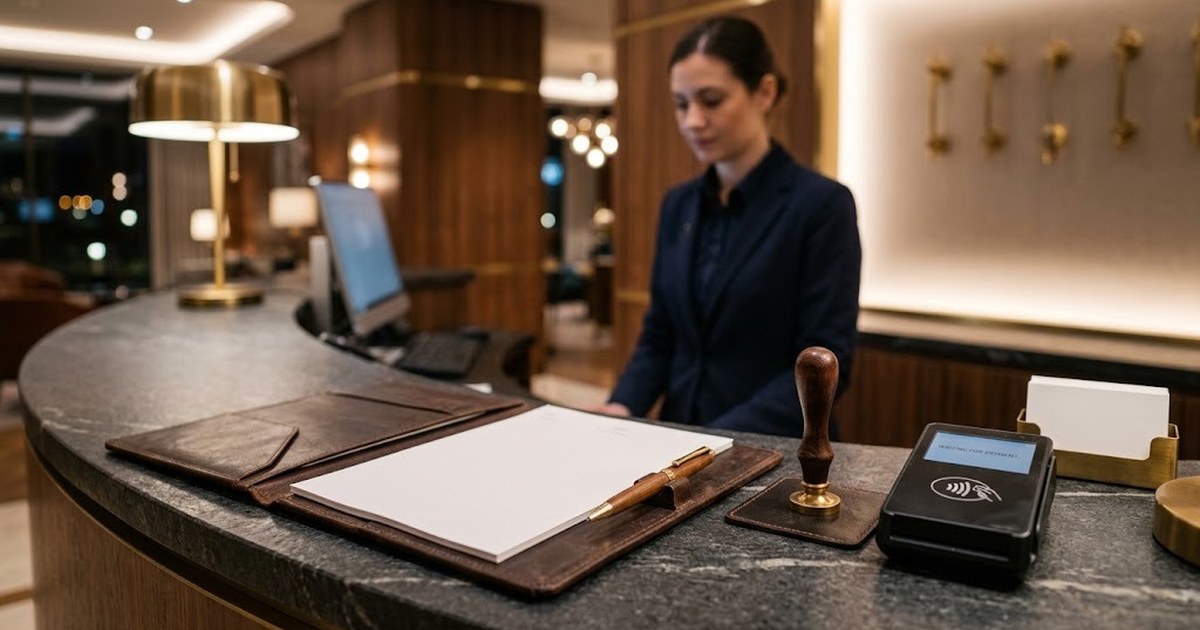
Corporate guests mean weekdays, early check-ins on schedule, and bookings that don't fall through at the last minute. But a hotel can keep a company only in one way: with the right documents. If accounting couldn't close the trip, next time it will choose the neighbor. Here is what exactly is expected from you.
This article is a review of practice, not tax advice. Check the details with your accountant and the current version of the Tax Code of Kazakhstan.
What the company asks for
| Document | Why the company needs it | When it is needed |
|---|---|---|
| Invoice for payment | Basis for payment from the current account | Before check-in or before payment |
| Act of services rendered | Confirms that the service was provided | After check-out |
| Electronic invoice (ESF) | Without it, VAT cannot be credited | Within 15 calendar days after the transaction |
| Fiscal receipt | When paying in cash or by card on site | At the moment of payment |
| Contract or guarantee letter | Confirms that the booking is corporate | Before check-in |
The invoice and the act must include the company's name, BIN, dates of stay, and the guest's last name. An error in the BIN turns the document into someone else's, and it will be sent back for revision.
The main mistake: a receipt in the guest's name
An employee arrives, pays with their own card, gets a fiscal receipt — and for the hotel the trip is closed. For the company it is not: the buyer in the documents became a person, not an organization. So VAT cannot be credited, and at a 16% rate on an invoice for 150,000 ₸ that is a loss of about 20,700 ₸.
What happens next is predictable: accounting asks for the documents to be redone, the front desk replies "the receipt has already been issued," and the company quietly removes the hotel from its list. And you will not be told about it.
How to avoid this situation: ask at check-in whether the stay is a business trip or a personal trip, and whether there is a guarantee letter. One sentence at the front desk saves the client.
The procedure that works for everyone
- Request with details. The company sends its name, BIN, address, the guest's last name, and the dates. It is convenient to set up a short request form and ask them to fill it in once, then keep a client record.
- Invoice to the legal entity. Issued before check-in; the company pays from its current account.
- Guarantee letter, if payment is made after check-out. This is normal practice for regular clients.
- Stay. The employee pays nothing and signs nothing except the guest card.
- Act and ESF after check-out. ESF — in the ESF information system under the company's BIN, within 15 calendar days after the transaction.
Prepayment or payment after check-out
The hotel wants money upfront, the company wants to pay based on actual use. A reasonable compromise that works in Kazakhstan:
- First booking — prepayment or a guarantee letter with details.
- Regular client — payment after the stay, by invoice, within 5–10 banking days; this condition is best recorded in the contract.
- Groups and events — partial prepayment and a payment schedule.
Payment after the stay is not a concession but a competitive advantage: it is precisely because of it that companies agree to work directly with the hotel rather than through intermediaries.
If the hotel is not a VAT payer
There will be no invoice, and the company has nothing to credit. This is not a verdict: the company will accept the expenses for corporate income tax based on the invoice, act, and receipt. But you need to say so before booking, not after: for accounting it affects the choice of hotel and the price comparison. An honest "we are not a VAT payer" inspires more trust than an ESF that never arrived.
Starting in 2026 the registration threshold dropped to 10,000 MCI, and many small hotels became VAT payers for the first time — what this means for a hotel.
Five mistakes that cost corporate clients
- A receipt in a person's name instead of an invoice to the company. The most common and the most expensive.
- ESF "someday." Late issuance — a fine for the hotel and a headache for the client.
- An error in the BIN or the company name. The document has to be issued again.
- No one responsible for corporate bookings. Requests arrive at a shared mailbox and get lost between shifts.
- A price "as on the storefront." The company compares with an aggregator and does not understand why it should work directly — how to calculate a corporate rate.
What to download
On the document templates page there are ready-made forms for hotels: a contract for corporate services, a corporate price list, and an act of services rendered. The guarantee letter is also there — you can send it to companies that do not know how to prepare it.
Questions and answers
Why doesn't a company accept a fiscal receipt issued to the guest?
Because the buyer named in the documents is a private individual. The company cannot claim VAT as a credit: for that it needs an electronic tax invoice (ESF) issued to its BIN. At a 16% rate that is a significant amount of money, and the accounting department will remember such a hotel.
Is a hotel required to issue an ESF?
If the hotel is a VAT payer and the buyer is a legal entity, the tax invoice is issued electronically in the ESF information system. If the hotel is not a VAT payer, there will be no tax invoice, and this should be told to the company right away.
Within what period should an ESF be issued?
No earlier than the date of the transaction and no later than 15 calendar days after it. For accommodation, the transaction date is usually the check-out day or the date of the act.
Is a contract needed with each company?
Not necessarily. A one-time booking can be accepted based on a company's guarantee letter and an invoice. A contract is convenient for regular stays: it sets out corporate rates, the payment procedure and cancellation terms.
Can payment be taken from the employee while the documents are issued to the company?
This is done, but it is risky: the documents must clearly show that the service was purchased by the company. It is more reliable to issue an invoice to the legal entity with a non-cash payment, and to give the employee a booking confirmation.
The text, translation and images for this article were prepared with the help of artificial intelligence. AI can make mistakes — check important figures, dates and requirements against official sources.
Companies book their employees' business trips on Rentus and pay by invoice. Joining is free; commission is charged only for completed stays.
 Photo generated by AI
12 October 2026Hotel Front Desk Scripts: Calls, WhatsApp and Message Templates
 Photo generated by AI
12 October 2026RevPAR, ADR and Hotel Occupancy: How to Calculate Them and What They Show
 Photo generated by AI
12 October 2026How to Reply to Guest Reviews on 2GIS and Google Maps: Rules and Templates
 Photo generated by AI
12 October 2026Hotel Sales Channels: How Not to Depend on a Single Aggregator
 Photo generated by AI
12 October 2026How to Fill a Hotel in the Off-Season: 10 Ways to Raise Occupancy
 Photo generated by AI
12 October 2026Where to List Your Hotel in Kazakhstan: Aggregators and Their Terms in 2026
 Photo generated by AI
10 October 2026Hotel Overbooking: Why a Room Gets Sold Twice and How to Prevent It
 Photo generated by AI
10 October 2026How to Open a Hotel in Kazakhstan: A Step-by-Step Plan for the Hospitality Business
 Photo generated by AI
10 October 2026Housekeeping in a Hotel: Types of Cleaning, Room Statuses, and the Housekeeper's Cart
 Photo generated by AI
10 October 2026Accommodation Contract with a Legal Entity: What to Specify in the Hotel Contract
 Photo generated by AI
10 October 2026Aparthotel: What It Is, How It Differs from a Hotel, and How to Run One in Kazakhstan
 Photo generated by AI
10 October 2026Hotel Receptionist: Duties, Shift Checklist and Key Skills
All articles
Occupancy, companies and documents for hotels