


Hotel Classification in Kazakhstan: Who Awards Stars and What Gets Checked
Only 3% of accommodation establishments have official stars. Who assigns the category, which documents are required, what is checked in the rooms, and what is changing in the classification.
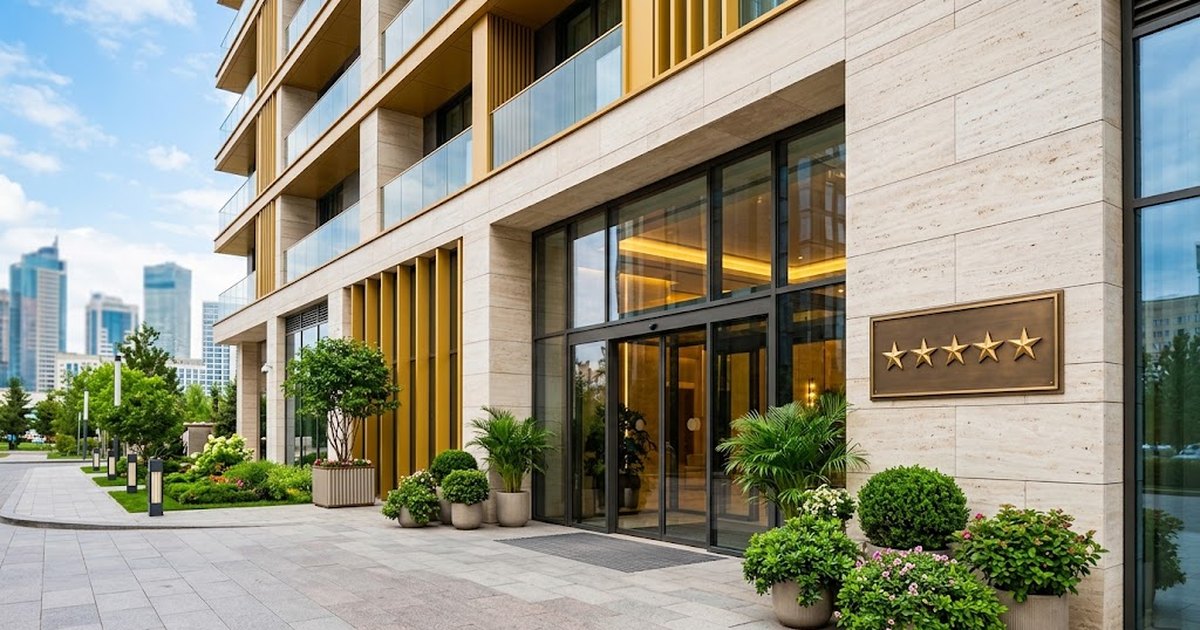
Stars on a hotel sign in Kazakhstan are not marketing; they are a category assigned under the Rules for Classifying Tourist Accommodation Facilities. In practice, only about 3% of establishments hold an official category: according to the Ministry of Tourism as of November 2025, that is 112 out of 4,442 registered accommodation facilities. Here is a look at who assigns stars, how classification works, what is checked, and what is changing.
An overview of the rules as of October 6, 2026, not legal advice. Before submitting an application, confirm the procedure and cost with the conformity assessment body.
What regulates classification
- Law "On Tourism Activity", Article 15-1: accommodation facilities are subject to classification, and the rules set out the objectives, minimum requirements, and procedure for assigning categories.
- Rules for Classifying Tourist Accommodation Facilities — approved in 2008, in force in the version of Order No. 144 of the Minister of Tourism and Sports dated July 24, 2025.
The category mark is from one to five five-pointed stars. The Rules name hotels, motels, campsites, tourist bases, guesthouses, holiday homes, and boarding houses as accommodation facilities, but detailed requirements are written mainly for hotels — the Ministry of Tourism calls this one of the gaps the new system should close.
Who assigns stars
The category is assigned by a conformity assessment body: it issues and records certificates and monitors whether the hotel complies with classification requirements. The validity period of the certificate is set under the Rules for Conformity Assessment (Order No. 433-NQ dated June 29, 2021).
The Ministry of Tourism identifies self-declared stars — when a property indicates a category without a certificate — as a problem: it misleads guests and undermines trust in the entire industry. If there is no certificate, do not display stars on the sign, the website, or booking platforms.
How classification works
- Application. The hotel submits an application and a questionnaire, using the forms from the appendices to the Rules, together with documents to the conformity assessment body.
- Preliminary review. The body considers the application within 30 calendar days, notifies of any deficiencies, and recommends how to correct them.
- On-site inspection. A commission visits the hotel and assesses it against the classification requirements and the point system.
- Decision. The body issues a certificate for the category or refuses.
Each next step begins only after the previous one is passed successfully. The total classification period under the Rules is no more than one month from the date of application.
The application is accompanied by:
- for legal entities — notarized copies of the charter and registration certificate; for individuals — a copy of the identity document;
- a lease agreement or a document certifying ownership of the building;
- contracts with qualified staff, without whom the accommodation facility cannot operate.
What is checked
The commission looks at the building and grounds, public areas, services, staff, and guest rooms. Some requirements are mandatory for a category, some give points, and the total score must be no lower than the threshold for the category.
The Rules also fix room names — worth knowing even if you do not plan to go through classification:
| Room | What it means under the Rules |
|---|---|
| Suite | At least 75 m², three or more rooms (living or dining room, study, bedroom), bed at least 180×200 cm, guest toilet |
| Apartment | At least 40 m², two or more rooms, kitchen equipment |
| Luxe | At least 35 m², two rooms — living room and bedroom, for one or two persons |
| Studio | One-room unit of at least 25 m² with a living or study area |
| Category I room | One room with one or two beds and a full bathroom |
| Category II room | One room with a partial bathroom, or a full bathroom shared by two rooms |
How stars change what is in the room
Take an ordinary Category I room. According to the table of room requirements in the Rules:
| What the guest is entitled to | From which hotel category |
|---|---|
| Towels: at least two per guest | 1–2 stars |
| Towels: at least three per guest | 3 stars |
| Towels: at least four per guest | 4–5 stars |
| Hair dryer, shampoo, shower cap, minibar glassware | 3–5 stars |
| Bathrobe, slippers, toothbrush and toothpaste, shower gel and lotion | 4–5 stars |
| Bar soap | All categories; in 1–3 stars a liquid soap dispenser is permitted |
In top-category rooms — luxe, studio, apartment, and suite — a bathrobe, slippers, and a hair dryer are required regardless of the hotel's star rating. For more on what to stock in rooms, see the article "Slippers, Bathrobes, and Towels for a Hotel".
What is changing
In November 2025, the Ministry of Tourism announced that it had prepared a new classification system taking into account approaches of the European Hotelstars Union: unified quality criteria based on international standards, a transparent assessment procedure, and inspectors who will be trained after the law is adopted. The amendments were sent to the Mazhilis.
As of the publication date, Article 15-1 of the law has not changed, and classification proceeds under the current Rules in the 2025 version. If you plan to undergo classification, follow the ministry's news: when the new criteria are introduced, the requirements for rooms may change.
Is classification worth it
- For: an official category is a clear signal to guests and partners about the standard; the inspection also shows what rooms and service are missing.
- Against: it takes time, documents, and spending on inspection, and rooms and areas will need to be brought up to the requirements of the category.
For corporate guests, stars are not the main thing: companies look at location, quiet, a workspace in the room, early breakfast, and the right documents for accounting. What matters to business travelers was covered in the article "Why Corporate Rates Benefit Hotels".
Questions and answers
Is hotel classification mandatory in Kazakhstan?
The law states that accommodation establishments are subject to classification, but in practice few have received a category: according to the Ministry of Tourism, as of November 2025, 112 of 4,442 accommodation establishments, or about 3%, were classified. You should not display stars without a certificate.
Who awards stars to a hotel?
The conformity assessment body: it reviews the application, carries out an on-site inspection with a commission, and issues a certificate for the category under the Rules for the Classification of Tourist Accommodation Establishments.
How long does classification take?
Under the Rules, the application is reviewed within up to 30 calendar days, and the overall classification process must not exceed one month from the date the application is submitted.
What documents are needed for classification?
An application and a questionnaire in the forms set out in the Rules, notarized copies of the charter and registration certificate (for a legal entity) or identity document (for an individual), documents for the building, and contracts with qualified staff.
From which category are a bathrobe and slippers required in the room?
In Category I rooms, which are found in 4- and 5-star hotels, they are required; a hair dryer, shampoo, and shower cap are required from 3 stars. In suites, studios, apartments, and luxury rooms, a bathrobe and slippers are required in a hotel of any category.
The text, translation and images for this article were prepared with the help of artificial intelligence. AI can make mistakes — check important figures, dates and requirements against official sources.
Companies book their employees' business trips on Rentus and pay by invoice. Joining is free; commission is charged only for completed stays.
 Photo generated by AI
12 October 2026Hotel Front Desk Scripts: Calls, WhatsApp and Message Templates
 Photo generated by AI
12 October 2026RevPAR, ADR and Hotel Occupancy: How to Calculate Them and What They Show
 Photo generated by AI
12 October 2026How to Reply to Guest Reviews on 2GIS and Google Maps: Rules and Templates
 Photo generated by AI
12 October 2026Hotel Sales Channels: How Not to Depend on a Single Aggregator
 Photo generated by AI
12 October 2026How to Fill a Hotel in the Off-Season: 10 Ways to Raise Occupancy
 Photo generated by AI
12 October 2026Where to List Your Hotel in Kazakhstan: Aggregators and Their Terms in 2026
 Photo generated by AI
10 October 2026Hotel Overbooking: Why a Room Gets Sold Twice and How to Prevent It
 Photo generated by AI
10 October 2026How to Open a Hotel in Kazakhstan: A Step-by-Step Plan for the Hospitality Business
 Photo generated by AI
10 October 2026Housekeeping in a Hotel: Types of Cleaning, Room Statuses, and the Housekeeper's Cart
 Photo generated by AI
10 October 2026Accommodation Contract with a Legal Entity: What to Specify in the Hotel Contract
 Photo generated by AI
10 October 2026Aparthotel: What It Is, How It Differs from a Hotel, and How to Run One in Kazakhstan
 Photo generated by AI
10 October 2026Hotel Receptionist: Duties, Shift Checklist and Key Skills
All articles
Occupancy, companies and documents for hotels