


Slippers, Robes and Towels for a Hotel: What the Room Must Have and How Much to Stock
Disposable slippers, robes, towels and a hairdryer: what the Classification Rules require for each category, how to choose, and how to calculate a month's supply.
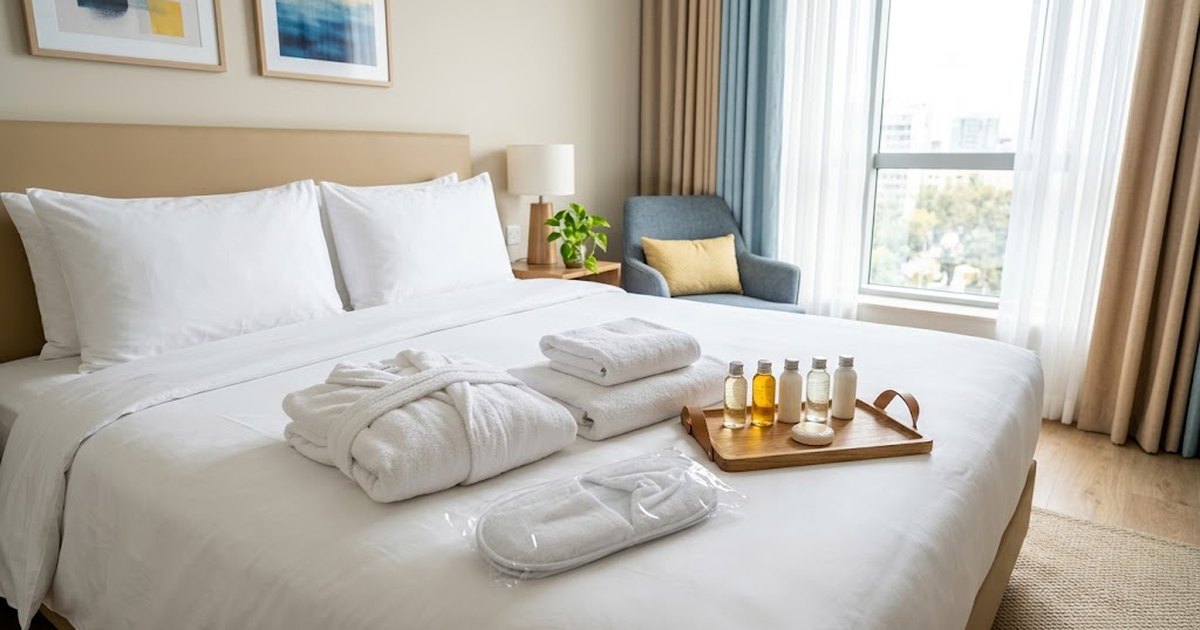
Disposable slippers, bathrobes, towels, linens and toiletries are expenses that guests notice right away, while the hotel counts them every month. Here is what the Kazakhstan Classification Rules require in a room, how to choose these items, and how much to order so you don't overpay or run out in high season.
The requirements below come from the table of room requirements in the Rules for Classification of Tourist Accommodation Facilities (2025 edition). Purchasing tips reflect hotel practice, not regulations.
What the Classification Rules require in a room
The Rules distinguish top-category rooms (suite, apartment, luxury, studio) and rooms of categories I–V. For a standard category I room — one room with a full bathroom — the requirements depend on the hotel's star rating:
| Required item | Category I room | Luxury, studio, apartment, suite |
|---|---|---|
| Bedding set: mattress with mattress protector, two pillows, a blanket and an additional blanket, bedspread, sheet, duvet cover, pillowcases | Always | Always |
| Towels per guest | At least 2 (1–2 stars), 3 (3 stars), 4 (4–5 stars) | At least 4; in a suite, at least 5 |
| Toilet soap | Always; in 1–3 star hotels a liquid soap dispenser is acceptable | Always |
| Hair dryer, shampoo, shower cap | From 3 stars | Always |
| Bathrobe, slippers, toothbrush and toothpaste, shower gel and lotion | From 4 stars | Always |
If a hotel has no official category, these requirements are not mandatory, but they are a useful benchmark: guests compare a room with what they have seen in hotels of the same level. For how to obtain an official category, see the article "Hotel Classification in Kazakhstan".
Disposable slippers: how to choose
- Closed or open toe. Closed toes are warmer and look more polished; open toes fit any foot size.
- Upper material. Non-woven fabric is the cheapest option for the economy segment; terry cloth and velour are for mid-range hotels and above.
- Sole. A thin sole tears on the first evening; a thick sole with a non-slip layer is safer on tile.
- Size and packaging. A one-size-fits-all option is common; individual packaging shows the guest the slippers are new.
- Logo. Embossing or printing a logo makes the slippers feel like "your" slippers; for small batches, ask in advance about the minimum order and the extra charge for printing.
How many slippers to order
One pair per guest per stay. It's convenient to calculate from the number of stays per month:
stays per month = rooms × occupancy × 30 ÷ average length of stay, then multiply by the average number of guests per room.
Example: 20 rooms, 60% occupancy, guests stay an average of 2 nights, and an average of 1.3 people per room. That gives 20 × 0.6 × 30 ÷ 2 = 180 stays, or about 234 pairs per month once guests are counted. Add a buffer for high season and for guests who ask for a second pair.
Bathrobes
- Terry cloth — the classic for rooms and spas; dense terry holds up to repeated washing better.
- Waffle weave — lighter, dries faster, suitable for warm seasons and the pool.
- Color — white: it can be bleached, and stains don't condemn the robe to write-off.
- Sizes — two popular sizes are usually enough, for example M and XL; children's robes if you host many families.
Bathrobes go to the laundry and sometimes leave with guests. Many hotels place a card in the room saying the robe can be purchased at reception: losses decrease, and the guest feels no awkwardness.
Towels and bed linen
Hotels usually keep several sets of towels and linen per bed in rotation: one in the room, one in the laundry, and one in reserve. If an outside laundry handles the linen and doesn't return it every day, you need a larger reserve.
- Color — white. It can be bleached at high temperatures, and batches from different years look the same.
- Linen fabric. Cotton feels nicer against the skin; a cotton-polyester blend lasts longer and wrinkles less after industrial laundering.
- Sizes — match real beds and duvets: linen cut "by eye" quickly turns into bunched sheets and unhappy reviews.
- Towel set — bath towel, hand towel and bath mat; the number per guest follows the table above.
Toiletries: bottles or dispensers
Guests like miniature bottles, but they add both cost and a lot of plastic. Dispensers for soap, shampoo and gel are cheaper per guest and look tidier. The Rules explicitly allow a liquid soap dispenser in 1–3 star hotels; if you are going through classification, check the remaining items with the conformity assessment body.
Hair dryer and small details guests notice
- Hair dryer — required in category I rooms from 3 stars and in all top-category rooms; a wall-mounted one is more reliable and less likely to disappear.
- Kettle, cups, water — especially for business guests who arrive late.
- Iron and ironing board — available at least on request: a business traveler needs a fresh shirt for a meeting.
- Outlet by the bed and at the work desk — a cheap upgrade that often gets mentioned in reviews.
Where to buy
- Wholesale suppliers of hotel textiles and consumables — price per batch, logo printing, delivery on schedule.
- Online marketplaces — convenient for small batches and urgent top-ups.
- Industry trade shows — for example, HoRex / CleanExpo, November 11–13; for other exhibitions taking place this autumn, see the exhibition calendar.
Before a large purchase, ask for samples and run a test: a few washes of a towel or a night in the room wearing the slippers will tell you more about quality than any description.
If your hotel works with companies, list its amenities on the hotel card on Rentus — hair dryer, bathrobes and slippers, iron, workspace. Companies see them on the hotel page when choosing where to accommodate an employee.
Questions and answers
Are slippers and robes mandatory in a hotel room?
Under the Classification Rules, in standard category I rooms a robe and slippers are mandatory for 4–5 star hotels, and in suites, studios, apartments and luxury rooms they are mandatory for hotels of any category. Hotels without a rating are not subject to these requirements.
How many towels must be provided to a guest?
In a category I room — at least two in 1–2 star hotels, at least three in 3 star hotels, and at least four in 4–5 star hotels. In top-category rooms — at least four, and in a suite — at least five.
How do I calculate how many disposable slippers to stock?
One pair per guest per stay. Stays per month = rooms × occupancy × 30 ÷ average length of stay, then multiplied by the average number of guests per room. For 20 rooms at 60% occupancy, a 2-night average stay and 1.3 guests, this comes to about 234 pairs per month.
Can dispensers be used instead of mini bottles?
Yes. The Classification Rules explicitly allow a liquid soap dispenser in 1–3 star hotels. If you are going through classification, check the remaining items with the conformity confirmation body.
From which category is a hairdryer mandatory in a room?
In category I rooms — from 3 stars; in top-category rooms — always.
The text, translation and images for this article were prepared with the help of artificial intelligence. AI can make mistakes — check important figures, dates and requirements against official sources.
Companies book their employees' business trips on Rentus and pay by invoice. Joining is free; commission is charged only for completed stays.
 Photo generated by AI
12 October 2026Hotel Front Desk Scripts: Calls, WhatsApp and Message Templates
 Photo generated by AI
12 October 2026RevPAR, ADR and Hotel Occupancy: How to Calculate Them and What They Show
 Photo generated by AI
12 October 2026How to Reply to Guest Reviews on 2GIS and Google Maps: Rules and Templates
 Photo generated by AI
12 October 2026Hotel Sales Channels: How Not to Depend on a Single Aggregator
 Photo generated by AI
12 October 2026How to Fill a Hotel in the Off-Season: 10 Ways to Raise Occupancy
 Photo generated by AI
12 October 2026Where to List Your Hotel in Kazakhstan: Aggregators and Their Terms in 2026
 Photo generated by AI
10 October 2026Hotel Overbooking: Why a Room Gets Sold Twice and How to Prevent It
 Photo generated by AI
10 October 2026How to Open a Hotel in Kazakhstan: A Step-by-Step Plan for the Hospitality Business
 Photo generated by AI
10 October 2026Housekeeping in a Hotel: Types of Cleaning, Room Statuses, and the Housekeeper's Cart
 Photo generated by AI
10 October 2026Accommodation Contract with a Legal Entity: What to Specify in the Hotel Contract
 Photo generated by AI
10 October 2026Aparthotel: What It Is, How It Differs from a Hotel, and How to Run One in Kazakhstan
 Photo generated by AI
10 October 2026Hotel Receptionist: Duties, Shift Checklist and Key Skills
All articles
Occupancy, companies and documents for hotels